AUG 13, 20266 mins min read
D+2 COD Remittance for D2C Brands: What It Means and Why It Kills Your Cash Flow
What D+2 COD remittance actually means for Indian D2C cash flow, how to model the working capital gap, and what it costs you at ₹10L+ monthly revenue.

I've spoken to founders doing ₹8-10 lakh a month in revenue who couldn't pay their courier invoice on time. Not because the business wasn't working. Because the money wasn't there yet.
That's a remittance problem. And most people building D2C brands in India don't model it until they're already stuck.
What D+2 actually means
Your courier delivers the order and collects the cash from the customer. That money is now sitting with them, not you. D+2 is the settlement term; the courier remits that collected cash to your bank account 2 business days after delivery.
On paper it sounds fine. Two days isn't long.
In practice it almost never works out that way.
Why it's never actually two days
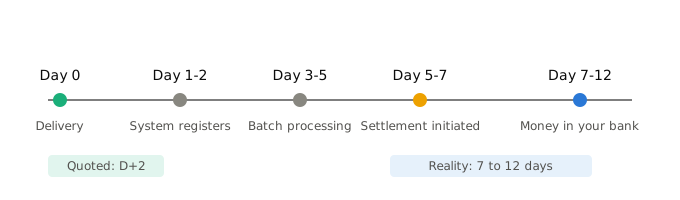
The D in D+2 is delivery date. But settlement doesn't start from when the package is delivered. It starts from when the courier's system registers and closes the delivery. Those are different things.
Couriers process settlements in batches, usually twice a week, sometimes weekly depending on your volume tier and agreement. If your delivery closes on a Tuesday evening, it might not hit the settlement batch until Thursday, which means remittance lands on Saturday. Bank holiday falls in that window? Add two more days minimum.
Across Delhivery, Xpressbees, Shadowfax, the actual number I've seen is 7 to 12 days from delivery to bank. During sale periods it went to 15. Courier ops get overwhelmed, reconciliation piles up.
The cash float nobody accounts for
Run the numbers once and you'll see why this compounds fast.
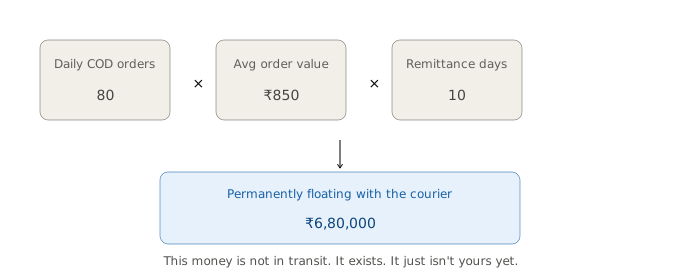
80 COD orders a day at ₹850 average. That's ₹68,000 leaving your customers' hands daily and going nowhere near your account.
If your average remittance cycle is 10 days, you have ₹6.8 lakh sitting in the courier's hands at any point in time. Not in transit. Not processing. Just floating.
At ₹15 lakh monthly revenue with a 60% COD mix, that float is roughly ₹5-6 lakh. Permanently. It doesn't come back because as old orders settle, new ones replace them.
That ₹5-6 lakh is working capital you can't touch. It's not profit. It's not savings. It's just gone from your operating account until the courier decides to send it.
If you're running ads simultaneously, paying your courier invoice monthly, and restocking inventory, you'll feel this gap before you understand what's causing it.
How different couriers handle it
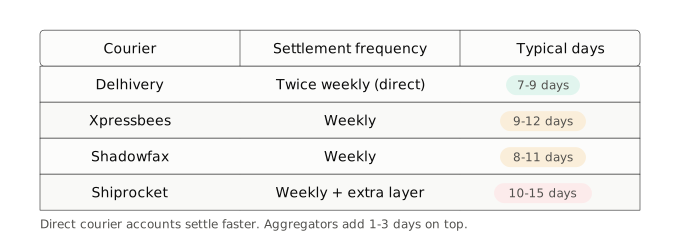
Settlement frequency varies and it matters more than the quoted D+2 figure.
Shiprocket aggregates multiple courier partners and adds its own settlement layer on top. That adds 1–3 days to whatever the underlying courier's cycle is. Convenient operationally, slower financially.
Delhivery direct accounts settle faster, usually twice weekly, if your volume qualifies you for a direct relationship. Below a certain shipment threshold you're going through a reseller and the cycle gets longer.
Shadowfax is faster on last-mile in tier 2 and 3 cities but settlement speed depends heavily on your account tier.
Xpressbees has weekly settlement as default for smaller accounts. Negotiable if you're doing consistent volume.
The honest answer: settlement speed is almost always negotiable once you cross 500-1000 shipments a month. Most founders never ask. They just accept whatever the default is.
How to model it before it becomes a problem
Simple calculation. Do it before you start scaling ad spend.
Take your projected daily COD shipments. Multiply by your average order value. That's your daily COD revenue.
Multiply that by your expected remittance days, use 10 as a conservative estimate if you don't have actual data yet.
That number is your permanent float. It needs to exist in your working capital before you scale. If it doesn't, you're borrowing from your ad budget or your restock budget to cover it and neither of those is designed for that.
Build the float into your P&L as a line item. Call it "courier float" or "settlement receivable." Treat it like inventory, capital tied up that you can't deploy elsewhere.
What actually helps
Shifting order mix toward prepaid is the most effective lever. Even a 10% shift from 65% COD to 55% COD changes your float meaningfully. Prepaid orders settle instantly through your payment gateway.
The standard prepaid incentive is ₹30–75 off or free shipping on prepaid. Test both. For most D2C categories, the discount converts better than the free shipping offer, but it depends on your AOV.
Negotiate settlement frequency directly with your courier once volume justifies it. Get it in writing. The default terms are designed for their convenience, not yours.
Don't use Shiprocket aggregation as your primary courier if cash flow is tight. The extra settlement layer costs you 2–3 days you probably can't afford at the beginning.
The question worth sitting with
Most founders I talk to discover the remittance gap around month three, usually right after a good sales week when they increased ad spend expecting the revenue to cover it, and then couldn't figure out why the bank account looked wrong.
If you went from 50% COD to 70% COD tomorrow because you ran a sale and COD converted better, how long would it take before you felt the float in your operating account?
If you don't know the answer to that, you haven't modeled it yet.
Working with a D2C brand?
If the numbers aren't adding up, that's usually fixable.
I take on a small number of D2C clients for paid acquisition, funnel work, and growth audits. If you're spending on Meta or Google and the economics feel off, email me. I'll tell you honestly what I see.
See how I work →