AUG 01, 20266 mins min read
What is ROAS And Why a Good Number Can Still Mean You're Losing Money
What ROAS actually measures, how to calculate your break-even ROAS for a D2C brand, and why a 4x can still mean you're losing money on every order.

Four times return on ad spend. Sounds like the campaign is working.
Sometimes it is. Sometimes the brand is losing money on every order and nobody has done the math yet.
ROAS gets reported in every performance review I have seen. It also gets misread in most of them. Not because people are careless because the metric looks complete when it is not.
The Definition First
ROAS = Revenue / Ad Spend
Spent ₹1 lakh on ads, got ₹4 lakh in orders. That is 4x. Simple.
What it does not tell you is whether ₹4 lakh in orders was worth spending ₹1 lakh to get. That depends on your costs. ROAS has no idea what your costs are.
A Campaign That Lost Money at 4x
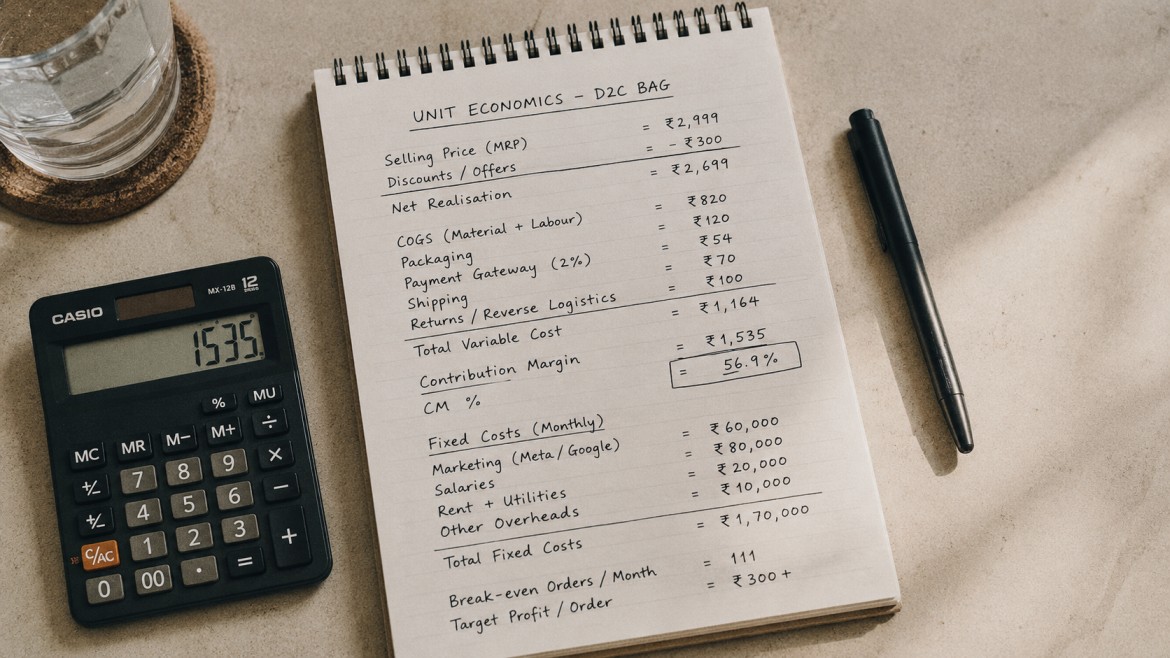
Product priced at ₹2,000. ₹50,000 in Meta spend, 100 orders. Revenue ₹2,00,000. ROAS 4x.
Pull the unit economics:
Product cost: ₹700
Shipping: ₹150
Returns at 8%: ₹160
Ad spend per order: ₹500
Left over: ₹490
₹49,000 in margin. ₹50,000 spent on ads. Net loss.
Nobody flagged it because ROAS looked fine.
This specific scenario plays out in Indian D2C more than the industry admits. High return rates, expensive logistics, products priced to look competitive. The dashboard stays green while the P&L bleeds.
ROAS does not see any of that. It sees revenue and spend. That is the whole picture it has.
So What Number Should You Actually Target

Your break-even ROAS. Not 4x. Not the benchmark from some marketing blog. Yours.
Break-Even ROAS = 1 / Gross Margin %
Gross margin at 40%? You break even at 2.5x. Profitable above that.
Gross margin at 20%? You need 5x just to cover what you spent. A 4x campaign is losing money every single day it runs.
The 4x rule of thumb assumes 25% net margin. If your business does not run at 25%, that number means nothing for you specifically.
Before the next campaign goes live, know what number you need. Work backward from margin, not forward from what sounds good.
Three Ways ROAS Misleads Even When You Know This

Attribution double-counting.
Meta's default window is 7-day click, 1-day view. Run Meta and Google at the same time and both platforms will claim credit for a chunk of the same orders. Each dashboard looks strong. Add them up and the total attributed revenue is higher than actual revenue. Somewhere in that gap is your real ROAS.
Retargeting inflates the overall number.
A retargeting campaign hitting 8x looks amazing in isolation. Those are warm audiences who already know the brand, maybe already planning to buy. The prospecting campaign at 1.8x is doing harder work against colder audiences. Kill the prospecting because the ratio looks weak and three months later the pipeline dries up. ROAS did not warn you.
First order and tenth order look identical.
₹2,000 from a new customer and ₹2,000 from someone who has bought nine times before. Same revenue, same ROAS contribution. Completely different business value. If LTV is strong enough, running acquisition below break-even ROAS is the right call. The metric will not suggest that. You have to know your own numbers well enough to override it.
How I Actually Think About It
ROAS is a fast read, not a verdict.
Check blended ROAS, not campaign-level. Total revenue divided by total spend across every channel. That is the real ratio.
If blended ROAS holds but margins are compressing, something in costs changed. The campaign numbers are covering it up. Usually shows up in fulfillment or returns before it shows up in the dashboard.
Set different targets for different campaign types. Retargeting should be hitting considerably higher than prospecting. Using the same benchmark for both is how you end up cutting the wrong campaigns.
And whenever someone shows a high ROAS screenshot without mentioning attribution window, audience temperature, or what the P&L looks like — that number is incomplete.
One Last Thing
The metric is not broken. The habit of using it as a final answer is.
Know what margin your business runs at. Calculate the ROAS you actually need. Then measure against that number, not a generic benchmark someone else pulled from their very different business.
What do you run campaigns against: ROAS, MER, or something else?
Working with a D2C brand?
If the numbers aren't adding up, that's usually fixable.
I take on a small number of D2C clients for paid acquisition, funnel work, and growth audits. If you're spending on Meta or Google and the economics feel off, email me. I'll tell you honestly what I see.
See how I work →